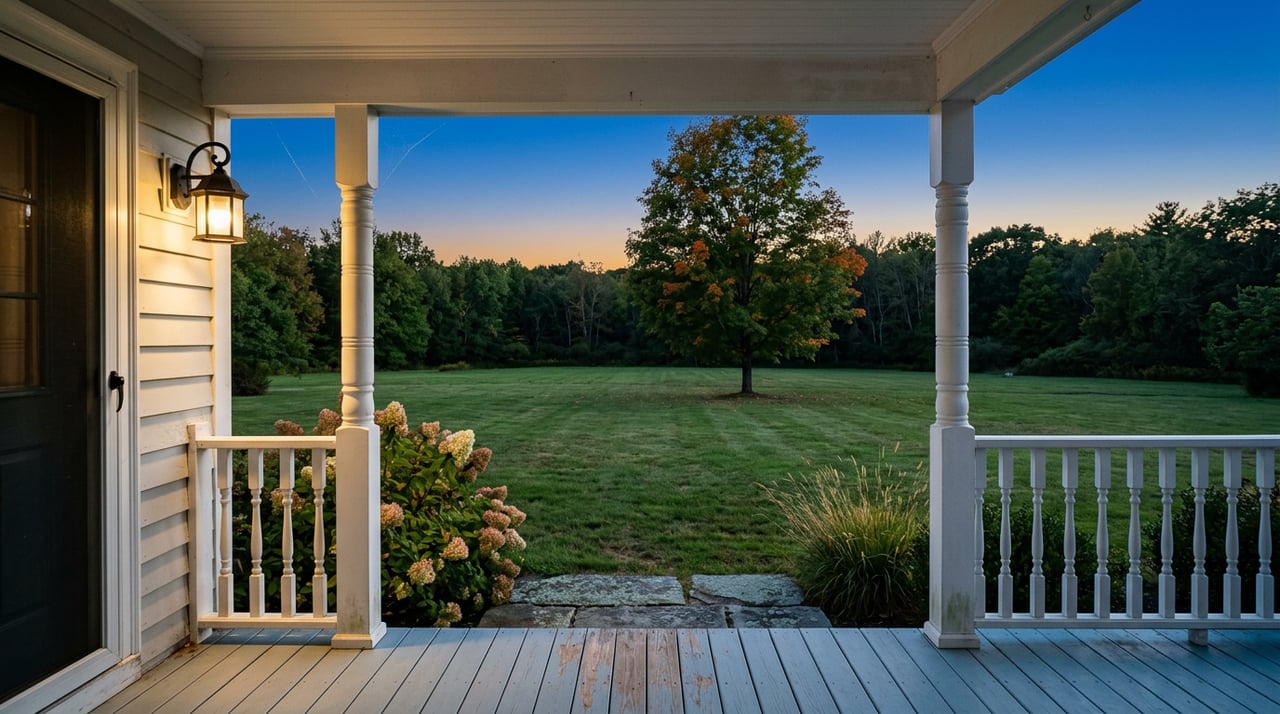
Picture the lot first: a shingled cape on Newman Road, marsh grass swaying past the back fence, a view that made the listing photos sell themselves. You close in June, spend July imagining a deck off the kitchen, and call a contractor in August. He asks one question before he asks anything else: has anyone measured the buffer zone yet?
If your answer is no, you are about to learn something the closing disclosure never mentioned. In Newbury, that question is not a formality. It is the actual gatekeeper for what you can build, and it applies to a much larger share of the town than most buyers assume.
The Math Nobody Runs Before Making an Offer
Newbury holds roughly 20 percent of the 25,000-acre Great Marsh, the stretch of salt marsh that runs from New Hampshire down to Gloucester, according to the state's Essex County Landscape Inventory reconnaissance report on the town. That is not a scenic backdrop confined to a few waterfront estates. It is a resource area that runs under, beside, and behind an enormous number of otherwise ordinary residential parcels, from Old Town Hill down through the Parker River corridor and out toward Plum Island.
Under the Massachusetts Wetlands Protection Act, any work within 100 feet of a wetland resource area or 200 feet of a river's edge falls inside a regulated buffer zone, and any activity in that zone requires review by the local Conservation Commission before a shovel goes in the ground. Given how much of Newbury's land touches marsh, river, or stream, that buffer zone is not an edge case here. It is close to the default condition for a large slice of the housing stock.
What Actually Triggers a Hearing
The list of triggers is longer than most buyers expect, and shorter than most contractors let on. Based on Newbury's own wetlands bylaw and the state regulations it implements, projects that typically require a filing include:
- Decks, additions, and pools within the buffer zone
- New driveways, sheds, or fences that involve grading or clearing
- Septic system work or drainage changes near a resource area
- Any construction that alters vegetation within 100 feet of marsh or wetland edge
There is one carve-out worth knowing if your lot sits inside Newbury's Parker River Residential District. The town's zoning bylaw includes a specific exemption for any parcel that already held a single-family home as of March 11, 1997. Those lots are deemed compliant regardless of later dimensional rules. A house built after that date inside the same overlay does not get the same protection. If you are comparing two nearly identical listings on the same street, the year one was built can matter more than the square footage.
The Order You Inherit, Not the One You Filed
An Order of Conditions applies to any successor in interest or successor in control of the property.
That line comes straight out of a recorded Order of Conditions on file with the Newbury Conservation Commission, and it is the detail that catches buyers off guard. When a previous owner went through the Notice of Intent process and received permission to build within the buffer zone, the resulting Order of Conditions gets recorded at the Registry of Deeds. It runs with the land, not with the person who applied for it. Buy the house, and you inherit both the permission and its limits.
Those orders are not permanent. Newbury's recorded orders are typically valid for three years from issuance, after which the work needs to be certified complete through a Certificate of Compliance or the permission lapses. A property can look finished and still carry an open, expiring order, or a lapsed one that quietly closed the door on further changes near the water. Neither shows up on a standard home inspection. Both show up at the Registry of Deeds, if you know to look.
The Landmarks That Prove the Rule
This is not a theoretical inconvenience dreamed up by a zoning attorney. It shows up in how the town's most visible conservation land actually gets managed.
At Old Town Hill Reservation, the Trustees of Reservations spent years working through environmental and regulatory permits before starting an 85-acre salt marsh restoration project, a first-in-Massachusetts use of a technique called ditch remediation to repair drainage patterns cut into the marsh more than three centuries ago. If a land trust with in-house ecologists needed that much lead time to get permitted, an individual homeowner planning a patio should expect the same commission, the same public hearing process, and the same paperwork, just at a smaller scale.
A few miles away, Spencer-Peirce-Little Farm carries an Agricultural Preservation Restriction across 191 of its 199 acres, land owned by Historic New England and still producing vegetables, flowers, and hay around a manor house dating to roughly 1690. It is a different mechanism than a wetlands order, an APR restricts development rather than requiring case-by-case review, but it tells the same story from another angle. In Newbury, a remarkable amount of land carries some form of standing restriction that outlives whoever currently holds the deed.
What the Price Tag Doesn't Say
Newbury's median sale price ran about $930,000 over the three months ending April 2026, down roughly 11.5 percent from the same period the year before, with the median price per square foot at $456. Portals that report numbers like that are reporting what closed, not what it took to get there. A marsh-adjacent lot that sold for less than a comparable inland property might reflect nothing more than a smaller footprint. It might also reflect a buyer who priced in the extra six to twelve weeks a Notice of Intent adds to any renovation timeline, or a seller who never resolved an open Order of Conditions before listing. The median treats both scenarios identically. Only a look at the parcel's own regulatory history tells you which one you are actually buying.
Before You Write an Offer
If a property you are considering sits anywhere near the Great Marsh, the Parker River, or the Little River, a few steps before you waive contingencies will save you a renovation season later:
- Pull the parcel's history at the Registry of Deeds for any recorded Order of Conditions, and check whether it was ever closed with a Certificate of Compliance.
- Contact Newbury's Conservation Agent directly and ask whether the lot falls inside a mapped buffer zone or riverfront area.
- Check the zoning bylaw for whether the parcel sits inside the Parker River Residential or Marine District, and if so, confirm when the existing structure was built relative to the March 11, 1997 grandfather date.
- If your plans include a deck, pool, or addition, request a Determination of Applicability from the Conservation Commission before you finalize your offer, not after.
None of this should scare a buyer away from marsh-adjacent Newbury. It should change what they ask for before they commit.
Frequently Asked Questions
Does this only apply to waterfront properties? No. The 100-foot buffer zone and 200-foot riverfront area can reach well inland from the visible marsh edge, so a lot without a water view can still fall inside regulated territory.
What if I only want to renovate the interior? Interior work that does not disturb soil, grading, or vegetation outside the existing footprint generally does not trigger Conservation Commission review. Anything touching the exterior footprint, drainage, or landscaping near the buffer zone should be checked first.
How long does the review process typically take? A straightforward Notice of Intent can move through a single public hearing in a matter of weeks, but more complex projects, or ones near a sensitive resource area like Old Town Hill's marsh, can take considerably longer once conditions and follow-up documentation are factored in.
Newbury's marsh is not a footnote to its housing stock. It is close to a structural feature of it, and buyers who treat it that way end up with fewer surprises after closing. If you are weighing a property near the water in Newbury, or trying to read what a recorded Order of Conditions actually means for your renovation plans, The Cronin Team can walk the parcel history with you before you write the offer, not after.